

If you’ve ever managed a team, you’ve seen it: personality clashes, rising tension, someone offended by something said—or unsaid—and small issues suddenly snowballing into team-wide dysfunction.
In my 20 years in HR, I’ve helped countless teams untangle issues around accountability, productivity, and morale. And while the surface problems varied, the root cause was usually the same: team silence.
I repeatedly saw teams unravel because people refused to speak up. No one wanted to address issues or identify expectations, and everyone assumed people would “just know” how to behave, respond, or interact.
The result: a breakdown in team dynamics, a rise in resentment, and a whole lot of avoidable drama.
The Solution: Team Norms
Team Norms are agreed-upon standards of behavior, communication, and interaction. They define what’s acceptable, what’s not, and how the team chooses to operate together.
Team norms shape culture, reinforce accountability, and most importantly, remove the guesswork.
Whenever I facilitated a team norms session, the shift was immediate. Teams went from vague frustration to clear alignment.
How It Works
I’d bring the entire team together for a working session and walk them through building their own norms. The team norms are not rules dictated by leadership, but shared expectations that everyone agrees to. Topics included:
- How we treat each other (respect, honesty, inclusion)
- What communication looks like (direct, timely, transparent)
- How we handle conflict (address it early, assume good intent)
- What happens when norms aren’t followed (accountability without hostility)
When the team builds it, the team owns it.
These weren’t just words on a whiteboard. They became something team members could lean on when tensions rose or behaviors went sideways. Once the list was finalized, I created a simple visual and printed hard copies for each team member. Everyone displayed the norms at their workstation as a daily reminder of how they agreed to show up for each other.
“Hey, remember we all agreed to give feedback respectfully and directly? What just happened didn’t feel like that.”
That kind of peer-to-peer accountability changes everything.
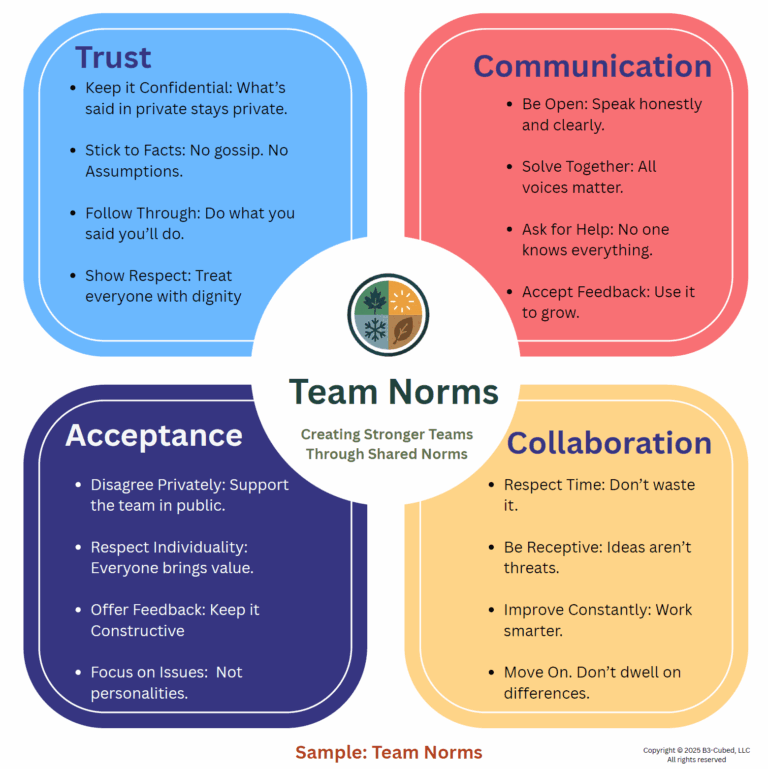
Norms in Action: Onboarding New Hires
One of the most underrated benefits of team norms is how seamlessly they integrate new hires into the culture.
When a new hire joins the team, cultural expectations are no longer a mystery. The team can clearly say, “Here’s how we operate. These are the norms we all agreed on.” It sets the tone early, reduces friction, and helps the new hire adapt faster to the team dynamic.
You simply hand them the team norms with their welcome packet and say: “Here’s how we work. This is what we expect from each other.”
No guesswork. No gray areas. And no “I didn’t know” excuses later.
Bonus: Use Them in Performance Reviews
Team norms also make annual evaluations easier. As a manager, you already have a clear, team-approved baseline of expectations. You can use it to evaluate not just results, but behavior and contribution to team culture.
The Foundation for Team Success
If your team is struggling with communication, accountability, or culture, start with team norms.
- Easy to create
- Easy to maintain
- Powerful enough to shift your entire team dynamic
They don’t have to be fancy. A simple, typed list on the wall is enough—as long as it’s built by the team and used by the team.
When the Graphic Isn’t Enough
Sometimes, a simple list isn’t going to cut it. Your team’s dysfunction may have reached a point where communication has completely broken down, and a visual reminder alone won’t fix it.
In these cases, you may need something more formal: The Team Norm Resolution Agreement.
This written agreement outlines how the team will handle conflict moving forward, and each team member signs it to acknowledge their individual accountability.
I once worked with a team of very strong, opinionated women—each of whom believed the others were the problem. The team norms graphic was helpful, but in this case, a signed agreement was necessary. We documented specific commitments for how they would act, communicate, and resolve issues. Once everyone signed, the tone of the team started to shift.
Most teams won’t need such drastic measures. But if dysfunction has been brewing for years, or trust is at an all-time low, implementing a formal agreement can provide the structure needed to reset expectations.
Need Help Creating Your Own?